
It’s not a bucket list. It’s a transaction — and someone else always pays the real price.
I want to start by saying I didn’t set out to have opinions about Mount Everest. I’m a travel lover. I believe in adventure, in chasing the uncomfortable, in going places that scare you a little. But I went down a rabbit hole at 3am last week during summit season, and I have not been able to close the tabs — or the moral reckoning — since.
So here it is. The thing I keep thinking about, the thing I think we don’t say loudly enough in the travel community: climbing Mount Everest, the way it’s currently done, is one of the most deeply selfish acts a person with money and free time can pursue. And I say that not to shame anyone, but because I think we owe it to ourselves — as travelers who care about the places and people we visit — to look at this clearly.
The Numbers
First, let’s talk about the scale of what’s happening right now.
This isn’t an abstract ethical debate. This is happening as I write this. It is summit season on Everest right now, in May 2026, and the mountain has never been more crowded or more consequential.
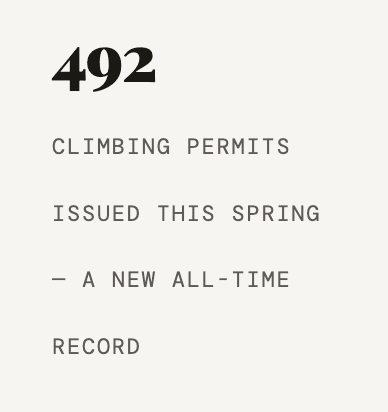

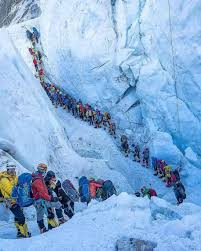
Two hundred and seventy people on one summit in one day. There are literal traffic jams in what’s called the Death Zone — the stretch above 26,000 feet where every extra minute without supplemental oxygen is costing you brain cells, fingers, or your life. People queuing for a photograph at the top of the world like it’s a ride for Disney World. They are on the brink of death, barely able to enjoy the view they sacrificed their health for.
Your Body on Everest:
What the Mountain Actually Does to You
Let’s start with the thing that’s hardest to fully comprehend until you read the details: Everest does not tolerate human beings. We are not built for it. Every single person who goes up there is fighting their own biology the entire way, and the mountain keeps score.
Above 26,000 feet — the Death Zone — the air contains only a third of the oxygen available at sea level. Your brain begins to malfunction. Your blood thickens, dramatically raising your risk of stroke and heart attack. Muscles stop recovering. Decision-making deteriorates in ways you cannot feel happening, which is perhaps the most terrifying part: you become less capable of recognizing that you are less capable. Climbers have sat down in the Death Zone to rest and simply never gotten back up.
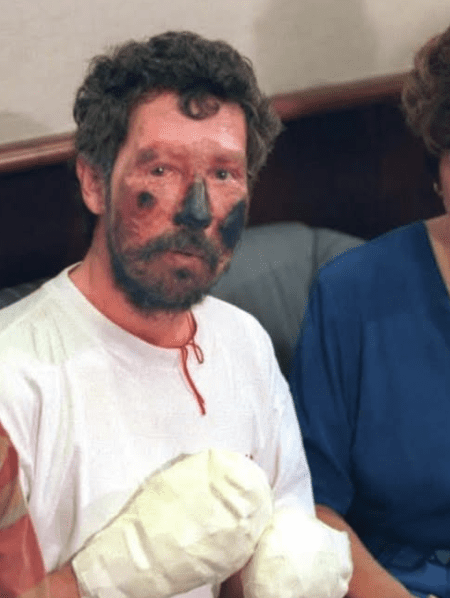
Frostbite is not a risk on Everest — it’s essentially a guarantee for anyone pushing to the summit. Fingers, toes, ears, noses. People come home missing parts of themselves. High-altitude cerebral edema — HACE — causes the brain to swell inside the skull. High-altitude pulmonary edema — HAPE — fills the lungs with fluid. Both can kill within hours. Both happen on Everest every single season.
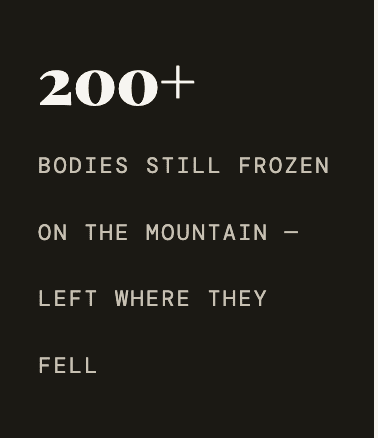
Over 300 people have died on Everest since expeditions began. More than 200 of those bodies are still up there — frozen where they fell, too dangerous and too expensive to retrieve. There is a stretch of the mountain nicknamed Rainbow Valley, named not for its beauty but for the brightly colored jackets of the dead climbers scattered across it. Climbers pass them on the way up. They use them as landmarks.
Experience Level:
And I know what you might be thinking — but what about experienced mountaineers? Surely someone with real skill is different? Here’s the thing: experts say that even a seasoned, experienced mountaineer needs a minimum of 3 to 4 years of dedicated high-altitude training before attempting Everest. That’s years, not months. Everest is rated a 9 to 10 on the mountaineering difficulty scale — the absolute top end of what exists. For reference, your everyday local trail hike is a 1. The Matterhorn — one of the most iconic and technically demanding peaks in the Alps, the one that kills people every year — is an 8. Everest is beyond that. And yet the permits keep selling.
And the reality is, the majority of people taking on this expedition haven’t even so much as attempted a Level 8 climb. We have people who are in way over their heads, wanting to pay their way through this experience. Which brings up some uncomfortable questions that I think deserve to be asked out loud: is this ego? Is the summit — the photo, the story, the bragging rights — worth more to these climbers than an honest reckoning with their own limitations? Is buying your way to the top of the world with a Sherpa doing the hard work actually an achievement? And perhaps most importantly — when your inexperience slows the route, triggers a rescue, or puts your guides in danger, at what point does your personal dream become someone else’s burden?
And the damage doesn’t end at the summit. Survivors routinely return with lasting neurological effects — memory loss, reduced cognitive function, vision damage. The “summit fever” that drives climbers to push past their body’s warnings has a clinical name: hypoxia-impaired judgment. Your brain, starved of oxygen, tells you the summit is worth dying for. And sometimes it is wrong.
If you couldn’t tell people you climbed Everest, would you still climb it?
No one will ever know you did. Not your family, friends, social media, or anyone. Only you would know. No pictures, no videos, no proof, no recognition, no bragging rights, no flexing… Would you still do it?
Just a thought that crossed my mind
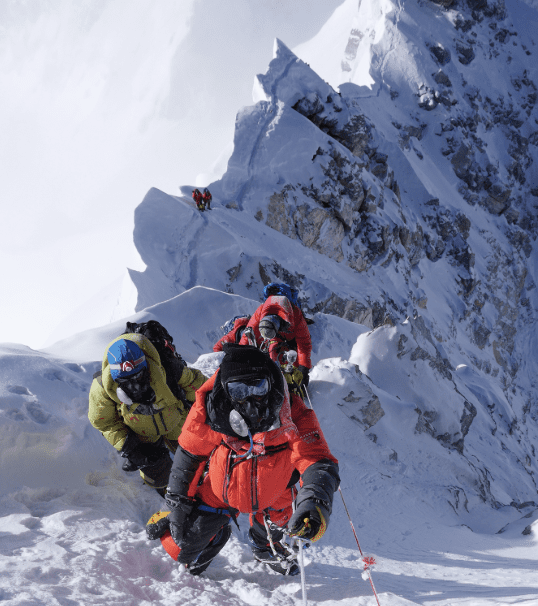
Now — you might be thinking: okay, but that’s their choice. They’re adults. If someone wants to risk their own fingers and brain cells chasing a personal dream, who are we to say they can’t?
Well. Here’s where it stops being just about you.
The Money:
What it actually costs — and what that money doesn’t buy you
Let’s talk about who does this. We’re talking about wealthy people — mostly from wealthy countries — who pay a small fortune for a guided trip to the highest point on Earth.
Most climbers spend between $45,000 and $130,000 for a single attempt. Some spend more than $200,000. The permit fee alone — just the government paperwork that lets you try — recently jumped to $15,000 per person. Before you’ve bought a single piece of gear, hired a single guide, or booked a single flight, you’re already $25,000 deep in mandatory fees.
There is more economic disparity and stratification at the summit of Everest than in Manhattan.”
Nick Deiuliis – “Hypocrisy of the Climbing Mount Everest Complex” (2021)
And here’s what that money gets you: the chance to be kept alive by someone else, on a mountain that doesn’t want you there, so you can say you did it.
The commercial Everest expedition exists to take people who could not survive the mountain on their own and move them to the top and back down through a combination of fixed ropes, bottled oxygen, and human labor. The mountain hasn’t gotten easier. The climbers have gotten less qualified. And the gap between those two things is filled by Sherpas.
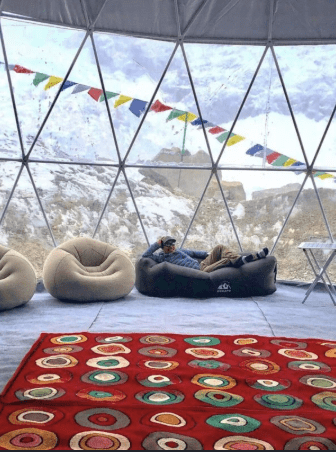
But here’s where it gets truly surreal. Because it’s not just about getting up the mountain anymore — it’s about doing it in style. At the top end of the market, companies like Climbing the Seven Summits now offer what they call a “Rugged Luxury” Everest experience. What does that look like? A 10-meter heated geodesic dome at base camp — they call it the “Big House” — outfitted with neon beanbag chairs, a library, a yoga area, a professional barista running an Italian espresso machine, and a ping pong table. There is a full spa tent offering 60-minute massages. Climbers sleep in private heated domes with queen-sized beds and personal humidifiers. The welcome includes champagne on the glacier. The meals are prepared by a chef flown in from Kathmandu.
Every single one of those amenities — the espresso machine, the massage table, the ping pong table, the champagne, the queen bed — had to get up that mountain somehow. And it didn’t walk there on its own. Sherpas and porters carry loads of up to 60 pounds through some of the most punishing terrain on the planet, so that someone can sip a cappuccino and play table tennis at 17,600 feet.
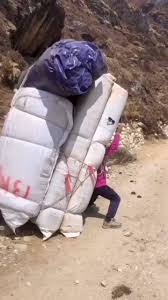
I want to be clear that this isn’t just an edge case or a novelty. The luxury segment of Everest expeditions is growing. And the logic it operates on — that the mountain is a backdrop for an experience you’ve purchased, rather than a place that demands something from you — has crept into the mainstream climbing culture too. When the mountain becomes a product, everything that holds it up becomes infrastructure. Including the people.
The Sherpas:
The people actually keeping everyone alive
This is the part that radicalized me. Because it’s not just that the Sherpa system is imperfect or that there’s room for improvement. It’s that the entire commercial Everest industry is built on a foundation of profoundly unequal risk.
And before we go further, let’s talk about something that rarely gets discussed in these conversations: Sherpas are not just experienced guides. They are physiologically extraordinary. This is not hyperbole — it is peer-reviewed science.
The Hard Facts:
A 2012 study published in PLOS ONE found that Sherpas carry genetic variants in the EPAS1 gene — the same gene found in Tibetan highlanders — that fundamentally alter how their bodies process oxygen at altitude. This gene, shaped by thousands of years of natural selection living above 3,000 meters, regulates how their hemoglobin responds to low-oxygen environments. Where a lowlander’s body panics and overproduces red blood cells (thickening the blood dangerously), a Sherpa’s system stays efficient and calm. A follow-up study in PNAS found that Sherpas also have metabolic advantages — their muscles use oxygen more efficiently at the cellular level, preserving energy in conditions that would cripple most people.
In plain terms: Sherpas are not just trained for Everest. They are, in a very real genetic sense, built for it. Their ancestors lived at these altitudes for centuries, and that history is written into their DNA. The mountain that is slowly killing the paying client is, for the Sherpa guide keeping them alive, something closer to home.
The records bear this out in staggering ways. Babu Chiri Sherpa spent 21 hours on the summit of Everest without supplemental oxygen in 1999 — a record that still stands. Ang Rita Sherpa summited Everest ten times, every single time without bottled oxygen, including once in the dead of winter — a feat no other person has ever replicated. These are not just athletic achievements. They are demonstrations of a physiology that is genuinely different from that of the people they guide.
So here is the thing that keeps me up at night: we have taken people who are biologically adapted to one of the harshest environments on earth, whose ancestors treated this mountain as sacred, and we have turned them into a support system for wealthy tourists who want a trophy. And we pay them a fraction of what those tourists spend on their espresso machine.
The Sad Truth:
A Sherpa guide earns roughly $3,000–$8,000 for the entire two-month climbing season — a salary expected to last the whole year. The client they are keeping alive paid up to $130,000 for the same trip. While that paying client passes through the treacherous Khumbu Icefall perhaps four times total, their Sherpa guide does it 30 to 40 times — loaded with oxygen tanks, tents, and supplies.
Think about that ratio. Four crossings versus forty. The Icefall is a moving, groaning maze of ice the size of buildings that can collapse without warning. It is where most Everest deaths occur. And the people doing it forty times are earning a fraction of what the people doing it four times paid.
One investigation called Sherpas “the most important piece of the logistical chain” while noting that they bear the greatest risks on the mountain. Another described it this way: no service industry in the world so frequently kills and maims its workers for the benefit of paying clients. The dead are often forgotten, and their families left with nothing.
In 2014, an avalanche killed 16 Sherpas in a single morning. The Nepalese government’s initial response was to offer each affected family $400. Four hundred dollars. For a life. After sustained protest and threatened strikes, they eventually established a relief fund — but it took mass death and public outcry to get there.
There are real arguments that Sherpa work pays significantly better than other available jobs in the region, and that’s true. But “it’s better than the alternative” is not the ethical ceiling we should be aiming for when people are dying to make rich foreigners’ dreams come true.
The Mountain Itself
What’s being left behind
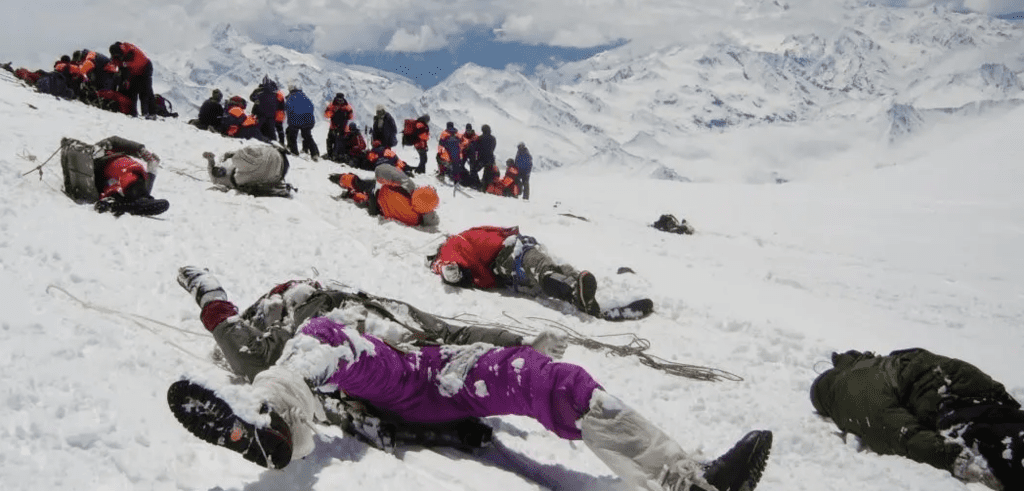
Here is a fact that I cannot stop thinking about: there is a place on Everest called Rainbow Valley. It is not named for its beauty. It is named for the colorful down jackets of the dead climbers strewn across its slopes. Over 200 bodies remain frozen on that mountain, left where they fell, because retrieving them would cost $60,000–$80,000 per body and risk the lives of the Sherpas tasked with the recovery.
Some of those bodies are so well-known they have nicknames. They are landmarks. Climbers navigate by them……. I have chills.
And the living aren’t doing much better for the mountain. During the spring 2024 season alone, waste management teams cleared 85 tons of garbage from the Everest region — including nearly 28 tons of human waste. At high altitude, in sub-zero temperatures, biological waste doesn’t decompose. It freezes. It stays. And when glaciers shift or temperatures rise, it leaches into the watershed.
Studies have found microplastics from synthetic climbing gear in Everest’s snow and streams at levels 100 times above normal background readings. The mountain that sits at the top of the world drains into rivers that serve over a billion people downstream. What happens on Everest doesn’t stay on Everest.
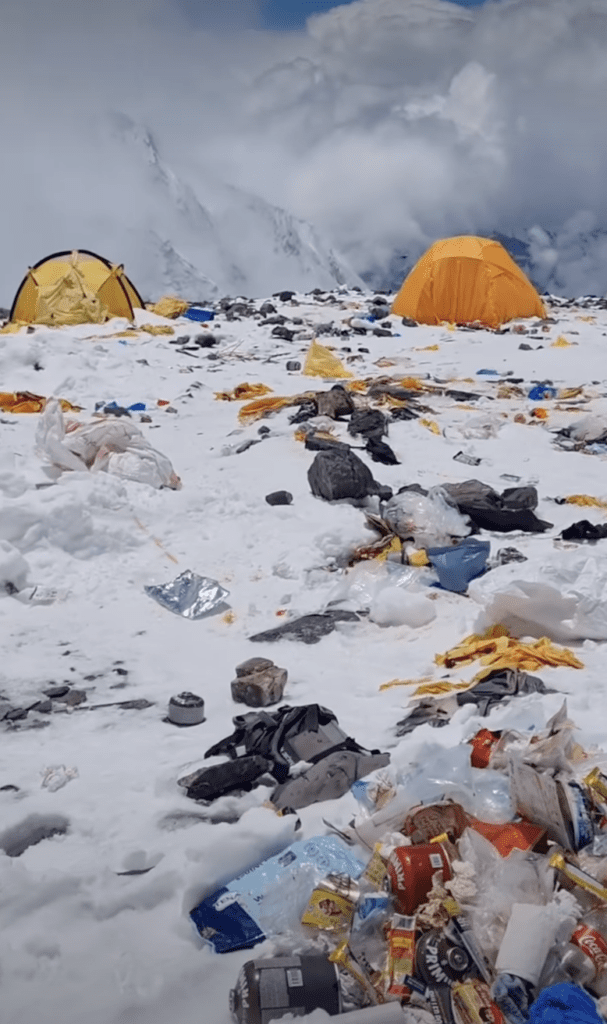
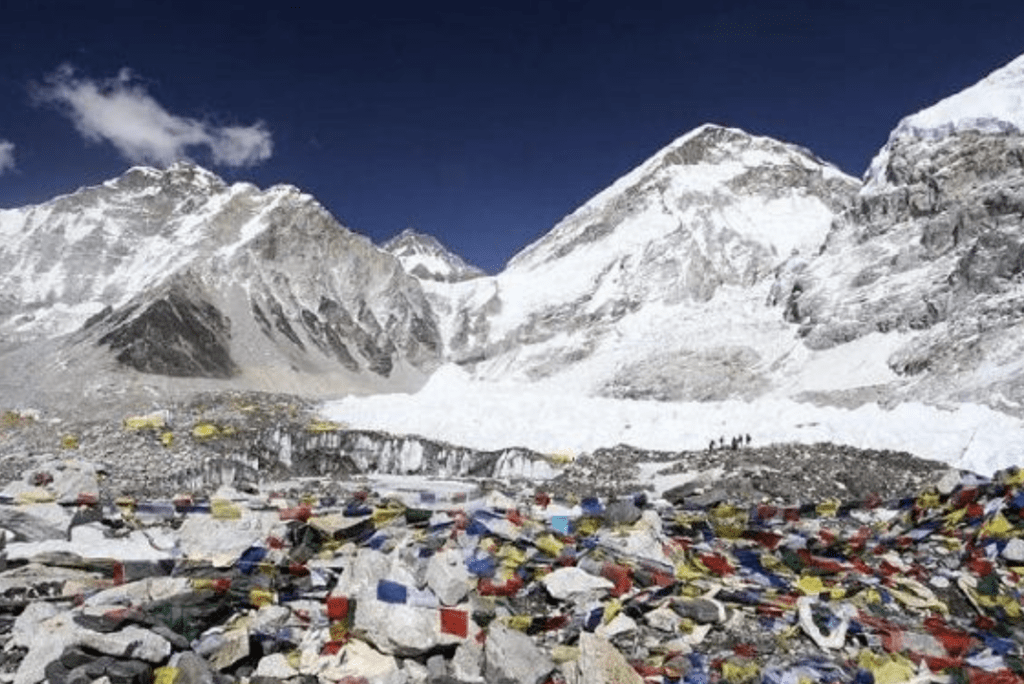
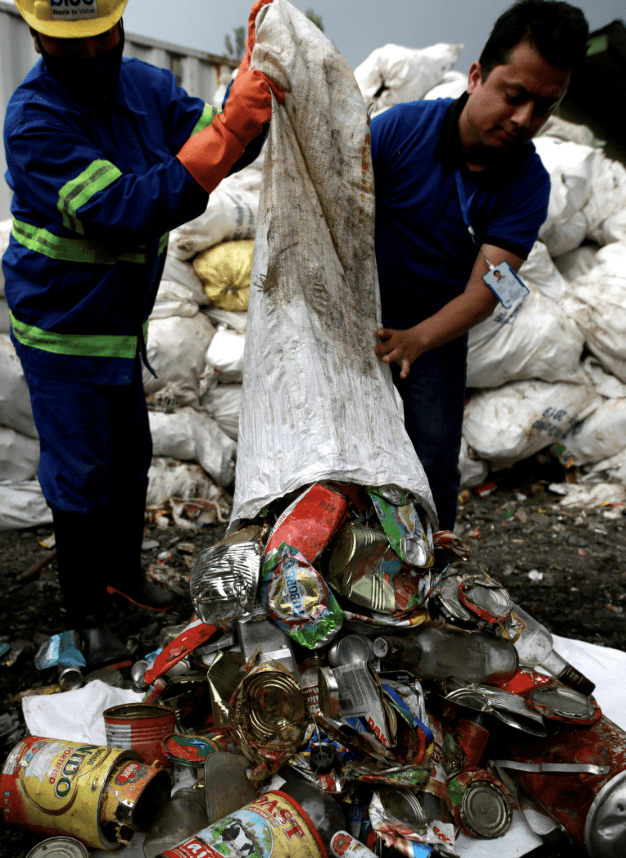
The Nepalese army runs cleanup campaigns every year. NGOs organize removal expeditions. Sherpas carry garbage down on their backs — charged by the kilogram — in a mountain of someone else’s making. And still, an estimated 40 to 50 tons of waste remain buried in the higher camps, unreachable and accumulating.
The Rescue Problem:
When things go wrong — and they always do
One more piece of this that doesn’t get talked about enough: what happens when something goes wrong, and who bears the cost.
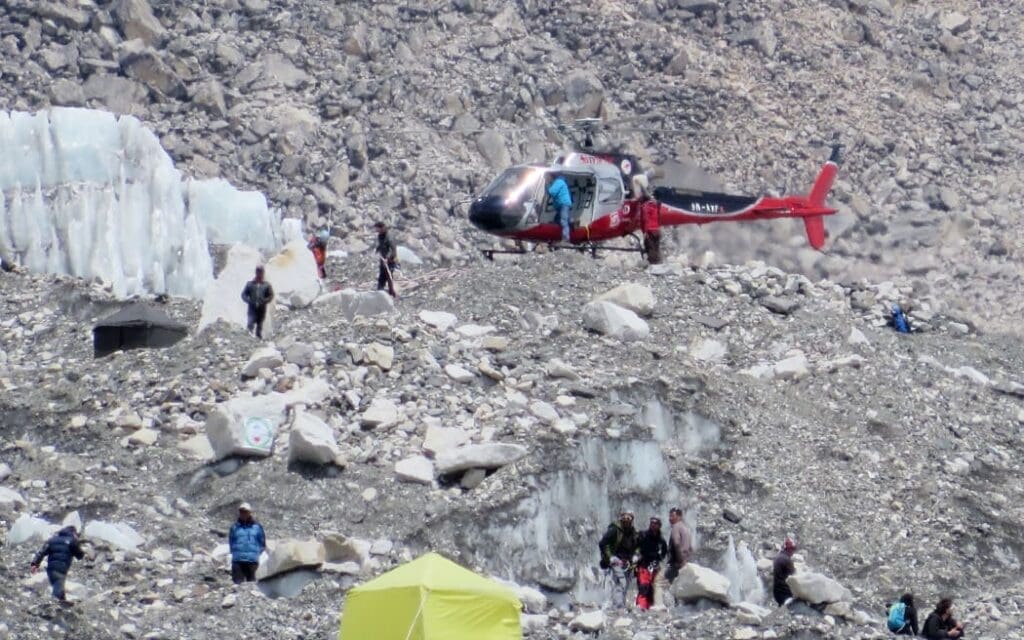
Emergency helicopter evacuation from the Everest region costs anywhere from $5,000 to $10,000 or more, depending on altitude and conditions. When a climber who wasn’t ready for the mountain gets into trouble — altitude sickness, frostbite, cardiac events, sheer exhaustion — pilots and crews have to fly into some of the most dangerous airspace on the planet to bring them down.
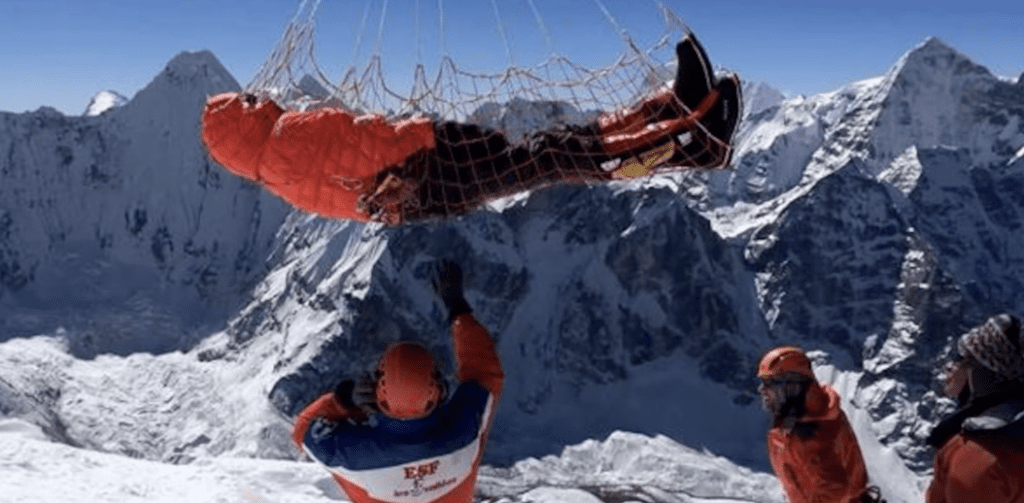
Everest also has a pipeline problem that’s gotten worse as the population of underprepared climbers has grown. The permits are increasingly going to people who have paid for the experience of summiting rather than trained for it. Budget operators accept clients with minimal mountaineering experience. And when those clients struggle, it’s not just their problem — it slows the routes, creates bottlenecks in the Death Zone, and puts guides and rescue teams in danger.
The Part That Stays With Me:
What I’m Actually Asking
I want to be clear: I’m not arguing that all adventure travel is bad, or that no one should ever climb a mountain. I’m not even arguing that Everest should be closed (though there are serious people making that case, and I think they deserve to be heard).
What I’m arguing is this: the current commercial Everest industry has made it possible for people who have no particular claim on that mountain to buy their way to the top, and in doing so, they are routinely offloading the cost — in labor, in risk, in environmental damage, in actual human life — onto the people who live there and work there.
When you spend $100,000 to stand on top of Everest for twenty minutes so you can say you did, you are not just going on a trip. You are participating in a system. And right now, that system chews up Sherpas, trashes one of the most sacred landscapes on the planet, and leaves bodies — literal human bodies — as trail markers for the people who come next.
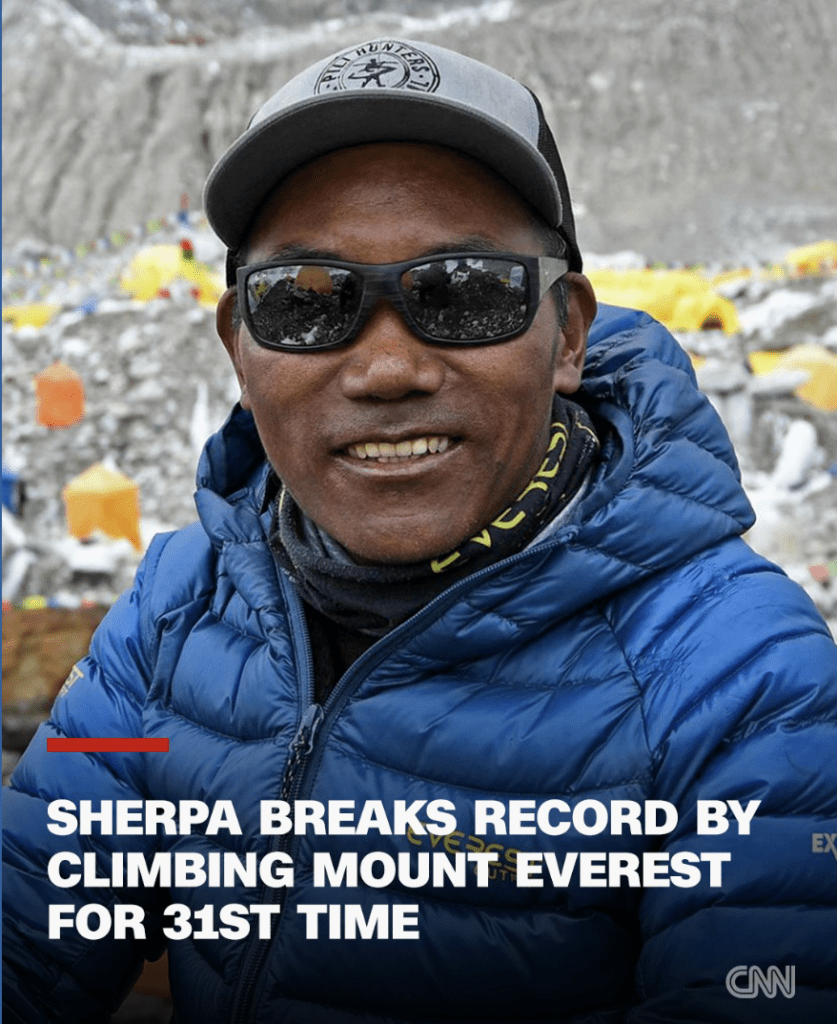
Kami Rita Sherpa summited Everest for the 32nd time this season. Thirty-two times. He’s 55 years old and has been guiding clients up that mountain since 1994. He’s done it so many times it barely makes the news anymore, except as a record. His name should be the one on every Everest documentary. Instead, we center the story on the people who paid him to be there.
I think we can do better. I think responsible travelers — especially those of us who see the world as something to be in relationship with, not just consumed — have to be willing to ask hard questions about the adventures we idolize. Even the beautiful, terrifying, world-record-breaking ones.
Especially those.
Queens — I need your take on this.
This community exists because we believe travel should make the world better, not just our Instagram feeds. So let’s actually talk about it.
—-> Does this change how you think about Everest or “bucket list” extremes?
—–> Is there a version of this that could be done ethically — or is the whole industry too broken?
—-> Where do we draw the line between adventure and exploitation?
—-> If you had $100,000 to spend on a once-in-a-lifetime trip, what would you actually do?
Drop your thoughts in the comments. No wrong answers — this is the conversation.


100% agree with this take. I think some areas of the planet should be seen, not experienced. It would take awhile to phase out for sure, and there would need to be assistance for the Sherpas who make their living facilitating climbs. But even if Everest was limited to base camp, that would seriously reduce the risks, deaths, and environmental impact. You’d still get to brag that you visited the tallest mountain in the world, get some amazing photos, meet some fascinating people, and support the local economy, without causing more harm.